Is This Pancreatic Cancer Operable? CT/MRI Staging and Resectability for Beginners
DOI:
https://doi.org/10.69734/xg0ksf87Keywords:
Pancreatic ductal adenocarcinoma, staging , CT , MRIAbstract
Is this Pancreatic cancer Operable? CT/MRI Staging and Resectability for Beginners
1.Overview
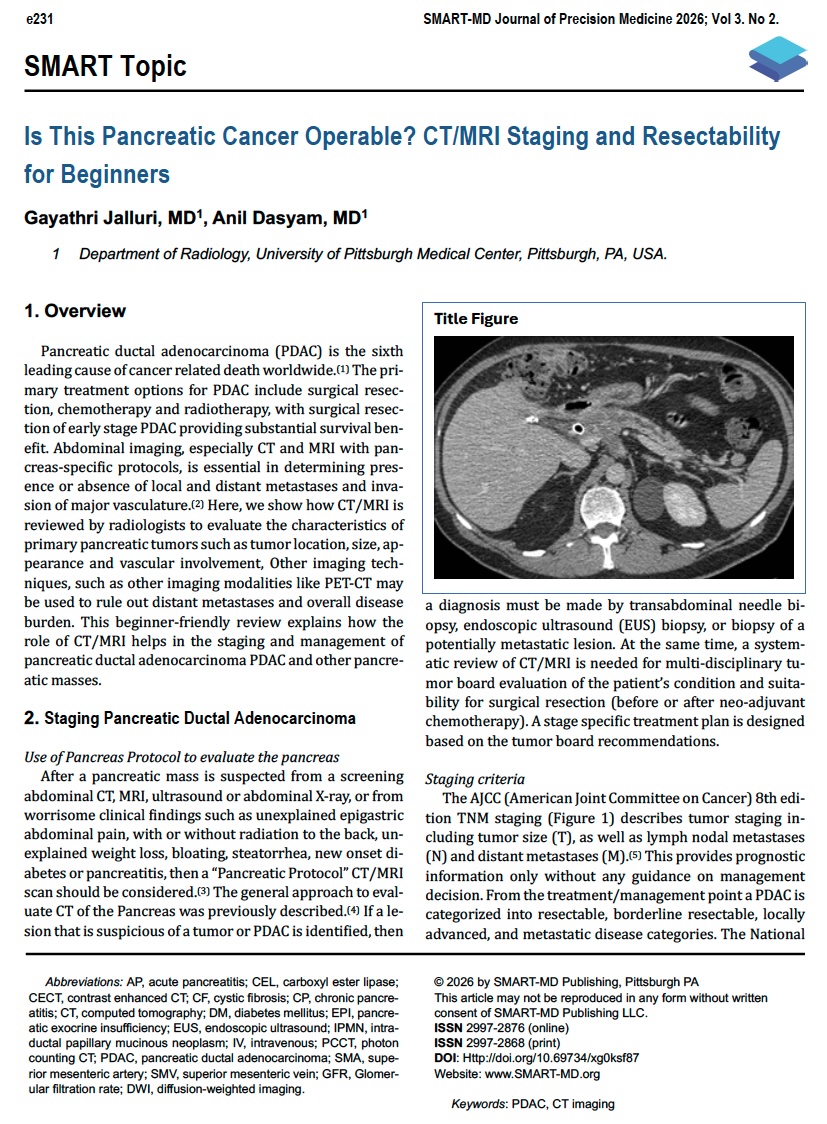
Pancreatic ductal adenocarcinoma (PDAC) is the sixth leading cause of cancer related death worldwide [1]. The primary treatment options for PDAC include surgical resection, chemotherapy and radiotherapy, with surgical resection of early stage PDAC providing substantial survival benefit. Abdominal imaging, especially CT and MRI with pancreas-specific protocols, is essential in determining presence or absence of local and distant metastases and invasion of major vasculature. Here, we show how CT/MRI is reviewed by radiologists to evaluate the characteristics of primary pancreatic tumors such as tumor location, size, appearance and vascular involvement. This beginner-friendly review explains how the role of CT /MRI helps in the staging and management of pancreatic ductal adenocarcinoma PDAC and other pancreatic masses.
2 .Staging of pancreatic ductal adenocarcinoma
After a pancreatic mass is suspected from a screening abdominal CT, MRI, ultrasound or abdominal X-ray, or from worrisome clinical findings such as unexplained epigastric abdominal pain with or without radiation to the back, unexplained weight loss, bloating, steatorrhea, new onset diabetes or pancreatitis, then a “Pancreatic Protocol” CT/MRI scan should be considered. The AJCC (American Joint Committee on Cancer) 8th edition TNM staging (Table 1) describes tumor staging including tumor size (T), as well as lymph nodal metastases (N) and distant metastases (M) [5]. This provides prognostic information only without any guidance on management decisions. From the treatment/management point a PDAC is categorized into resectable, borderline resectable, locally advanced, and metastatic disease categories. The National Comprehensive Cancer Network (NCCN) guidelines”, is one of the most used systems, to provide recommendations on the management and the determination of resectability for PDAC
3 .Imaging Technique and Protocol, CT/MRI features of PDAC
Dedicated multiphasic CT and MRI protocols with use of intravenous contrast play a key role in imaging of PDAC to assess resectability and staging. Using a structured template is recommended for reporting Pancreatic mass Protocol CT scan helps in accurate inclusion of all the findings to determine resectability of the tumor
4. Use of CT / MRI in a PDAC surveillance program for individuals at high risk
Several hereditary/familial syndromes and genetic mutations are associated with increased incidence of pancreatic cancer. The American college of gastroenterology guidelines recommend MRI and EUS as screening modalities.
5.Future directions: Emerging serum tumor markers in Pancreatic Cancer
Several New emerging biomarkers like miRNAs, MUC1, L1CAM and GATA6 for pancreatic adenocarcinoma are described recently. Dimitros et Al suggest that these newer biomarkers increase in the accuracy of the diagnosis and help to individualize the treatment
Conclusion
Pancreas protocol CT is the modality of choice in diagnosis and staging of PDAC per the NCCN guidelines. Pancreas protocol MRI/MRCP can provide complementary information to CT and is superior to CT for pancreatic ductal assessment and detection of small isodense pancreatic masses. Lack of ionization radiation makes MRI the ideal choice when screening for PDAC. Structured reporting template is recommended for radiology reports to ensure consistent and comprehensive assessment of PDAC.
References
Leiphrakpam, P.D., et al., Trends in the Global Incidence of Pancreatic Cancer and a Brief Review of its Histologic and Molecular Subtypes. J Gastrointest Cancer, 2025. 56(1): p. 71.
https://www.nccn.org/professionals/physician_gls/pdf/pancreatic.pdf.
Feger J, Campos A, Raymond Chieng S, et al. CT pancreas (protocol). Reference article, Radiopaedia.org (Accessed on 17 Mar 2026) https://doi.org/10.53347/rID-90195.
Baytar, Y., D.C. Whitcomb, and A.K. Dasyam, CT Images of the Pancreas for Beginners. SMART-MD Journal of Precision Medicine, 2025. 2(4).
Shin, D.W. and J. Kim, The American Joint Committee on Cancer 8th edition staging system for the pancreatic ductal adenocarcinoma: is it better than the 7th edition? Hepatobiliary Surg Nutr, 2020. 9(1): p. 98–100.
Treadwell, J.R., et al., Imaging Tests for the Diagnosis and Staging of Pancreatic Adenocarcinoma: A Meta-Analysis. Pancreas, 2016. 45(6): p. 789–95.
Aslanian, H.R., J.H. Lee, and M.I. Canto, AGA Clinical Practice Update on Pancreas Cancer Screening in High-Risk Individuals: Expert Review. Gastroenterology, 2020. 159(1): p. 358–362.
Syngal, S., et al., ACG Clinical Guideline: Genetic Testing and Management of Hereditary Gastrointestinal Cancer Syndromes. Official journal of the American College of Gastroenterology | ACG, 2015. 110(2): p. 223–262.
Stefanoudakis, D., et al., Emerging Tumor Biomarkers in Pancreatic Cancer and Their Clinical Implications. Curr Issues Mol Biol, 2025. 47(5).
Downloads
Published
Versions
- 2026-06-06 (2)
- 2026-05-31 (1)
Issue
Section
License
Copyright (c) 2026 SMART-MD Journal of Precision Medicine

This work is licensed under a Creative Commons Attribution 4.0 International License.
 Journal information