DPYD Genotype-guided Dose Optimization of 5-Fluorouracil in Individuals with Pancreatic Cancer
DOI:
https://doi.org/10.69734/ca9xy367Keywords:
DPYD, DPD, 5FU, pancreatic ductal adenocarcinoma, pancreatic cancer, 5-FU, 5-fluorouracil, 5 fluorouracil, FOLFIRINOXAbstract
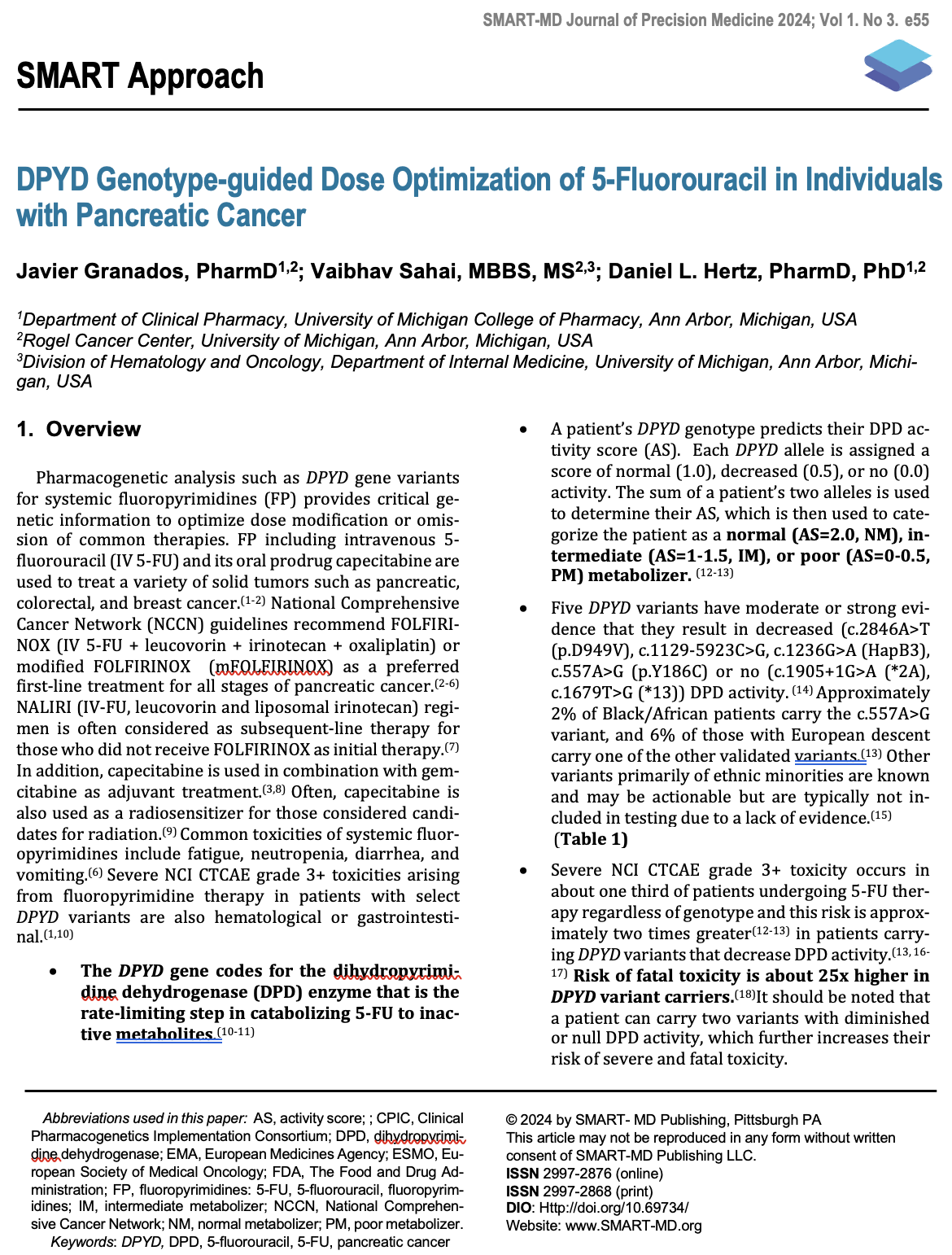
Systemic fluoropyrimidines (FP) including intravenous 5-fluorouracil (IV 5-FU) and its oral prodrug capecitabine are used to treat a variety of solid tumors such as pancreatic, colorectal, and breast cancer. National Comprehensive Cancer Network (NCCN) guidelines recommend FOLFIRINOX (IV 5-FU + leucovorin + irinotecan + oxaliplatin) or modified FOLFIRINOX (mFOLFIRINOX) as a preferred first-line treatment for all stages of pancreatic cancer. NALIRI (IV-FU, leucovorin and liposomal irinotecan) regimen is often considered as subsequent-line therapy for those who did not receive FOLFIRINOX as initial therapy. In addition, capecitabine is used in combination with gemcitabine as adjuvant treatment. Often, capecitabine is also used as a radiosensitizer for those considered candidates for radiation. Common toxicities of systemic fluoropyrimidines include fatigue, neutropenia, diarrhea, and vomiting. This expert review highlights the effects of genetic variants in the DPYD gene and provides recommendations for adjusting 5-FU dose based on pharmacogenetics.
References
Shakeel F, Fang F, Kwon JW, et al. Patients carrying DPYD variant alleles have increased risk of severe toxicity and related treatment modifications during fluoropyrimidine chemotherapy. Pharmacogenomics. 2021;22(3):145-155. doi:10.2217/pgs-2020-0154
Buckley CW, O'Reilly EM. Next-generation therapies for pancreatic cancer. Expert Rev Gastroenterol Hepatol. 2024;18(1-3):55-72. doi:10.1080/17474124.2024.2322648
NCCN Clinical Practice Guidelines in Oncology, Pancreatic Adenocarcinoma (Version 3. 2024). 2024 August 2, [cited 2024 Oct 9]. Available from: https://www.nccn.org/professionals/physician_gls/pdf/pancreatic.pdf
Sohal DPS, Kennedy EB, Cinar P, et al. Metastatic Pancre-atic Cancer: ASCO Guideline Update. J Clin Oncol. 2020;38(27):3217-3230. doi:10.1200/JCO.20.01364
Balaban EP, Mangu PB, Khorana AA, et al. Locally Ad-vanced, Unresectable Pancreatic Cancer: American Soci-ety of Clinical Oncology Clinical Practice Guideline. J Clin Oncol. 2016;34(22):2654-2668. doi:10.1200/JCO.2016.67.5561
Conroy T, Desseigne F, Ychou M, et al. FOLFIRINOX ver-sus gemcitabine for metastatic pancreatic cancer. N Engl J Med. 2011;364(19):1817-1825. doi:10.1056/NEJMoa1011923
Wang-Gillam A, Hubner RA, Siveke JT, et al. NAPOLI-1 phase 3 study of liposomal irinotecan in metastatic pan-creatic cancer: Final overall survival analysis and charac-teristics of long-term survivors. Eur J Cancer. 2019;108:78-87. doi:10.1016/j.ejca.2018.12.007
Neoptolemos JP, Palmer DH, Ghaneh P, et al. Comparison of adjuvant gemcitabine and capecitabine with gemcita-bine monotherapy in patients with resected pancreatic cancer (ESPAC-4): a multicentre, open-label, randomised, phase 3 trial. Lancet. 2017;389(10073):1011-1024. doi:10.1016/S0140-6736(16)32409-6
Ross A. Abrams et al., NRG Oncology/RTOG 0848: Results after adjuvant chemotherapy +/- chemoradiation for pa-tients with resected periampullary pancreatic adenocar-cinoma (PA). JCO 42, 4005-4005(2024). doi:10.1200/JCO.2024.42.16_suppl.4005
Etienne-Grimaldi MC, Pallet N, Boige V, et al. Current diagnostic and clinical issues of screening for dihydropy-rimidine dehydrogenase deficiency. Eur J Cancer. 2023;181:3-17. doi:10.1016/j.ejca.2022.11.028
Thorn CF, Marsh S, Carrillo MW, et al: PharmGKB sum-mary: Fluoropyrimidine pathways. Pharmacogenet Ge-nomics 21:237-242, 2011
Johnson MR, Diasio RB. Importance of dihydropyrimidine dehydrogenase (DPD) deficiency in patients exhibiting tox-icity following treatment with 5-fluorouracil. Adv Enzyme Regul. 2001;41:151-157. doi:10.1016/s0065-2571(00)00011-x
Morris SA, Moore DC, Musselwhite LW, et al. Addressing barriers to increased adoption of DPYD genotyping at a large multisite cancer center. Am J Health Syst Pharm. 2023;80(19):1342-1349. doi:10.1093/ajhp/zxad117
Nguyen DG, Morris SA, Hamilton A, et al. Real-World Impact of an In-House Dihydropyrimidine Dehydrogen-ase (DPYD) Genotype Test on Fluoropyrimidine Dosing, Toxicities, and Hospitalizations at a Multisite Cancer Cen-ter. JCO Precis Oncol. 2024;8:e2300623. doi:10.1200/PO.23.00623
Pratt VM, Cavallari LH, Fulmer ML, et al. DPYD Genotyp-ing Recommendations: A Joint Consensus Recommenda-tion of the Association for Molecular Pathology, American College of Medical Genetics and Genomics, Clinical Phar-macogenetics Implementation Consortium, College of American Pathologists, Dutch Pharmacogenetics Working Group of the Royal Dutch Pharmacists Association, Euro-pean Society for Pharmacogenomics and Personalized Therapy, Pharmacogenomics Knowledgebase, and Pharmacogene Variation Consortium. J Mol Diagn. 2024;26(10):851-863. doi:10.1016/j.jmoldx.2024.05.015
Meulendijks D, Cats A, Beijnen JH, Schellens JH. Improv-ing safety of fluoropyrimidine chemotherapy by individu-alizing treatment based on dihydropyrimidine dehydro-genase activity - Ready for clinical practice?. Cancer Treat Rev. 2016;50:23-34. doi:10.1016/j.ctrv.2016.08.002
Merloni F, Ranallo N, Scortichini L, Giampieri R, Berardi R. Tailored therapy in patients treated with fluoropyrim-idines: focus on the role of dihydropyrimidine dehydro-genase. Cancer Drug Resist. 2019;2(3):787-802. Published 2019 Sep 19. doi:10.20517/cdr.2018.006
Sharma BB, Rai K, Blunt H, Zhao W, Tosteson TD, Brooks GA. Pathogenic DPYD Variants and Treatment-Related Mortality in Patients Receiving Fluoropyrimidine Chemo-therapy: A Systematic Review and Meta-Analysis. Oncologist. 2021;26(12):1008-1016. doi:10.1002/onco.13967
Henricks LM, Lunenburg CATC, de Man FM, et al. DPYD genotype-guided dose individualisation of fluoropyrimi-dine therapy in patients with cancer: a prospective safety analysis. Lancet Oncol. 2018;19(11):1459-1467. doi:10.1016/S1470-2045(18)30686-7
Knikman JE, Wilting TA, Lopez-Yurda M, et al. Survival of Patients With Cancer With DPYD Variant Alleles and Dose-Individualized Fluoropyrimidine Therapy-A MatchedPair Analysis. J Clin Oncol. 2023;41(35):5411-5421. doi:10.1200/JCO.22.02780
European Medicines Agency (2020) New testing and treatment recommendations for fuorouracil, capecita-bine, tegafur and fucytosine. https://www.ema.europa.eu/en/documents/referral/fuorouracil-fuorouracil-related-substances-article-31-referral-new-testing-treatment_en.pdf. Accessed 7 Oct 2024
Argilés G, Tabernero J, Labianca R, et al. Localised colon cancer: ESMO Clinical Practice Guidelines for diagnosis, treatment and follow-up. Ann Oncol. 2020;31(10):1291-1305. doi:10.1016/j.annonc.2020.06.022
Amstutz, U. et al. Clinical Pharmacogenetics Implementa-tion Consortium (CPIC) guideline for dihydropyrimidine dehydrogenase genotype and fluoropyrimidine dosing: 2017 update. Clin. Pharmacol. Ther. 103, 210–216 (2018).
Lunenburg, C. et al. Dutch Pharmacogenetics Working Group (DPWG) guideline for the gene-drug interaction of DPYD and fluoropyrimidines. Eur. J. Hum. Genet. 28, 508–517 (2019).
Fluorouracil [package insert]. Fresenius Kabi, 2016. https://www.accessdata.fda.gov/drugsatfda_docs/label/2024/202669s009lbl.pdf
Capecitabine [package insert]. Genentech Inc, 2022. https://www.accessdata.fda.gov/drugsatfda_docs/label/2022/020896s044s045s046s047s048s049s050s051lbl.pdf
Innocenti F, Mills SC, Sanoff H, Ciccolini J, Lenz HJ, Milano G. All You Need to Know About DPYD Genetic Testing for Patients Treated With Fluorouracil and Capecitabine: A Practitioner-Friendly Guide. JCO Oncol Pract. 2020;16(12):793-798. doi:10.1200/OP.20.00553
Tamraz B, Venook AP. DPYD Pharmacogenetics: To Opt-in or to Opt-out. JCO Oncol Pract. 2024;20(8):1009-1011. doi:10.1200/OP.24.00255
Golan T, Hammel P, Reni M, et al. Maintenance Olaparib for Germline BRCA-Mutated Metastatic Pancreatic Can-cer. N Engl J Med. 2019;381(4):317-327. doi:10.1056/NEJMoa1903387
Nie Q, Shrestha S, Tapper EE, Trogstad-Isaacson CS, Bouchonville KJ, Lee AM, et al. Quantitative Contribution of rs75017182 to Dihydropyrimidine Dehydrogenase mRNA Splicing and Enzyme Activity. Clin Pharmacol Ther. 2017;102(4):662-70 D.O.I: 10.1002/cpt.685. PMID: 28295243
Turner AJ, Haidar CE, Yang W, Boone EC, Offer SM, Em-pey PE, et al. Updated DPYD HapB3 haplotype structure and implications for pharmacogenomic testing. Clin Transl Sci. 2024;17(1):e13699 D.O.I: 10.1111/cts.13699. PMID: 38129972
Offer SM, Fossum CC, Wegner NJ, Stuflesser AJ, Butter-field GL, Diasio RB. Comparative functional analysis of DPYD variants of potential clinical relevance to dihydro-pyrimidine dehydrogenase activity. Cancer Res. 2014;74(9):2545-54 D.O.I: 10.1158/0008-5472.CAN-13-2482. PMID: 24648345
Offer SM, Wegner NJ, Fossum C, Wang K, Diasio RB. Phenotypic profiling of DPYD variations relevant to 5-fluorouracil sensitivity using real-time cellular analysis and in vitro measurement of enzyme activity. Cancer Res. 2013;73(6):1958-68 D.O.I: 10.1158/0008-5472.CAN-12-3858. PMID: 23328581
Shrestha S, Zhang C, Jerde CR, Nie Q, Li H, Offer SM, et al. Gene-Specific Variant Classifier (DPYD-Varifier) to Identify Deleterious Alleles of Dihydropyrimidine Dehy-drogenase. Clin Pharmacol Ther. 2018;104(4):709-18 D.O.I: 10.1002/cpt.1020. PMID: 29327356
Downloads
Published
Versions
- 2024-12-26 (6)
- 2024-12-26 (5)
- 2024-12-26 (4)
- 2024-12-26 (3)
- 2024-12-26 (2)
- 2024-12-23 (1)
Issue
Section
License
Copyright (c) 2024 SMART-MD Journal of Precision Medicine

This work is licensed under a Creative Commons Attribution 4.0 International License.
 Journal information